 Interlocking W-block system
Interlocking W-block system
Interlocking W-block system

Precast concrete systems
ReadyAquawall is a patented system of interlocking precast concrete blocks — engineered for the rapid, demountable construction of retaining walls, sea defences and flood barriers. There's no need to excavate trenches or lay conventional foundations, and the blocks come with built-in piling or pinning options to anchor securely to almost any ground.
The system
The W-shaped blocks have central slots that interlock with the course above and below, forming a centrally pitched series of holes ready for piling or filling as required.
This makes ReadyAquawall the first ready-made bore-piled retaining wall of its kind — strong enough for permanent riverbank, harbour and sea-defence work, yet rapid enough for temporary flood walls and traffic partitioning that disassemble for storage once the need has passed.
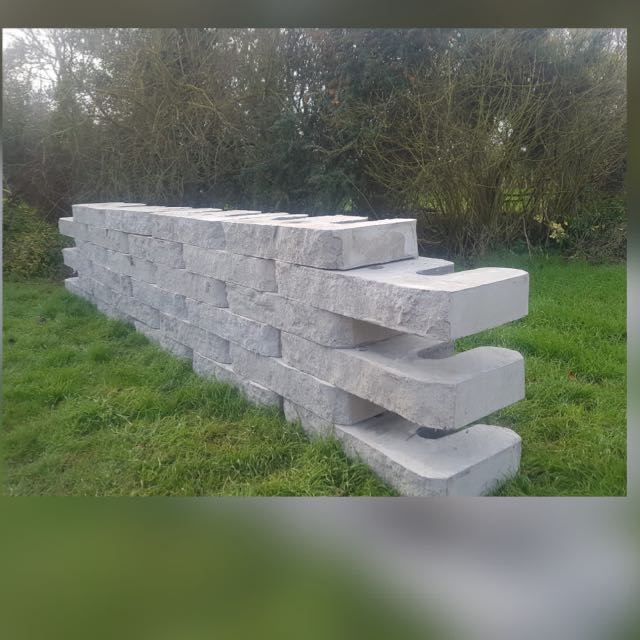
On site
A short field film from a flood-protection project, featuring Aquacast International's founder on site as the system goes into the water.
The process
Aquacast production is mobile. A complete casting plant ships to site, comes off the trailer, and begins producing finished interlocking blocks where they're needed — cutting out the haulage, the lead times and the carbon of shipping precast units across continents.
In motion
Two short animations of the patented method — the W-block reinforcing a riverbank, and the V-block forming a sea defence.
Why it works
A rigid, fast construction that can be dismounted, stored and re-assembled at another site — with minimal environmental disturbance and considerable savings in time and material.
Concrete mix and steel reinforcement vary for light or heavy applications. Overlapping at half-block lengths gives a rigid format; cavities take piling at any depth where ground stability demands it.
The precast, interlocking design resists earth pressure, settlement and turnover forces — extending working life with no foundation trenches except on the highest permanent walls.
Sustainability
Available with a cement-free concrete mix that sharply cuts the CO₂ released in manufacture — lowering the carbon footprint of the whole structure.
Nothing is mixed or poured on site, with minimal ground disturbance — and every block is demountable and reusable, so far less waste than traditional construction.
Textured faces and open cavities let vegetation take hold and marine life colonise — turning hard sea and river defences into living habitat.
Design data
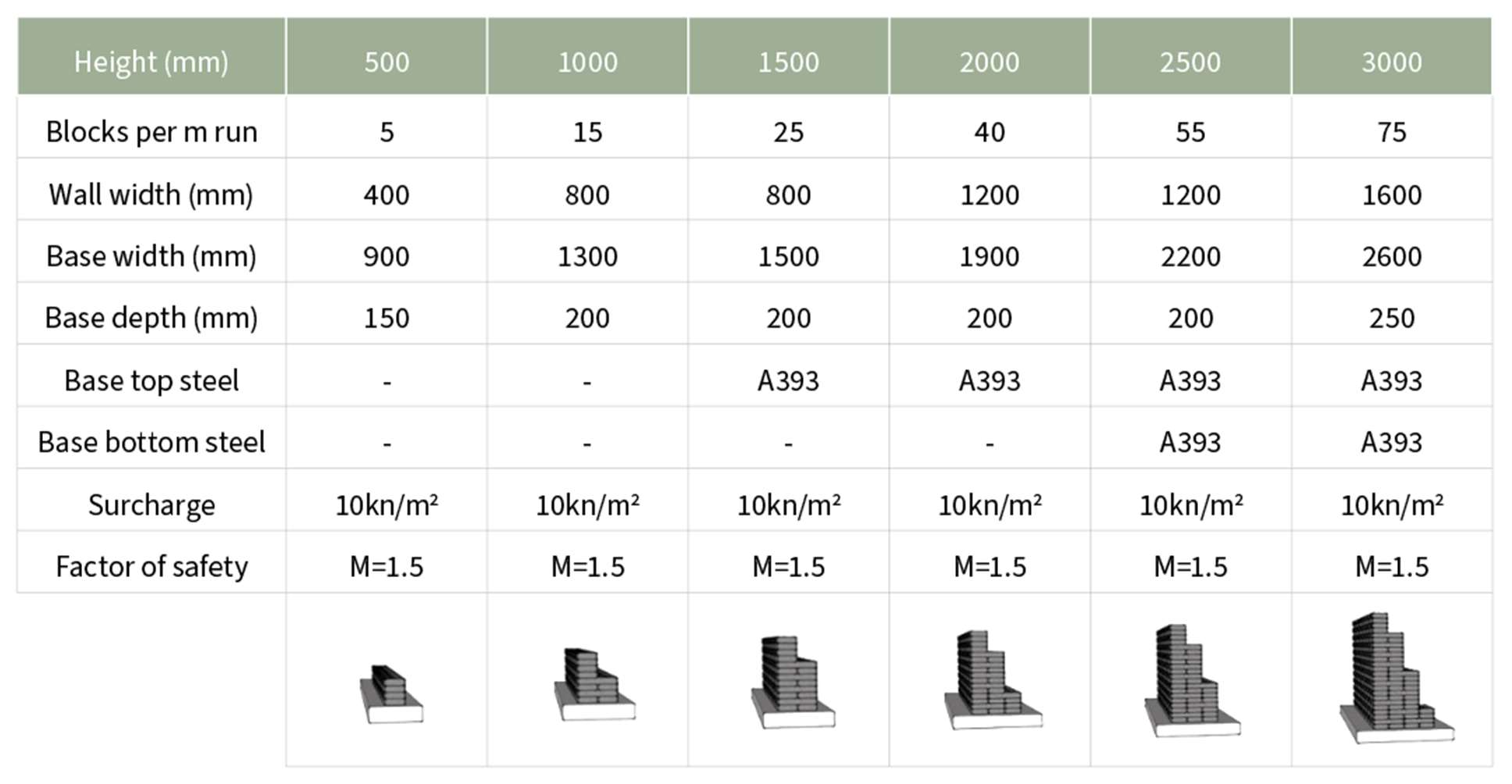
Indicative block counts, wall and base dimensions, reinforcement and factor of safety for finished wall heights from 500 to 3000 mm — straight from the Aquacast design brochure.
Where it's used
A wide range of sizes, designs and finishes makes the system suitable for permanent structures requiring strength and temporary works requiring speed.
Casts slot onto piles and locate underwater until the build rises above the waterline.
View application → A.2Several cast patterns combat land erosion and movement, with 90° supports to resist turnover.
View application → A.3Reinforce failing walls by piling in front or behind — no demolition required.
View application → A.4Polyurethane membranes sandwiched between casts keep water out — or hold it in.
View application →From the field
An excellent alternative to traditional revetments like gabion baskets and pile sheets — no foundation required, significant retaining properties, long-lasting, and it can be laid in a certain depth of water.
Jacqui Howard · Miles Water Engineering
From first site inspection and survey through manufacturing to final construction — backed by geotechnical, structural and civil engineers.